
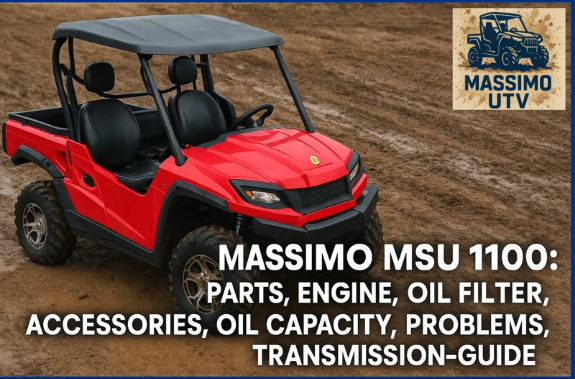
The Massimo MSU 1100 is a strong side-by-side with a 1085cc V-twin engine, producing 38 horsepower for work and fun. Priced at $12,000–$14,000, it offers selectable 2WD/4WD, a 2000-pound towing capacity, and a dump bed. Made by Massimo Motor Sports, it competes with the Hisun 1100 ($12,000) and Polaris Ranger 1000 ($15,000).
It has a 10-inch ground clearance, 27-inch tires, and standard extras like a 4500-pound winch. The liquid-cooled EFI engine runs reliably, and the CVT transmission shifts smoothly. This guide covers parts, engine details, oil filter, accessories, oil capacity, problems, transmission, and care tips, helping owners keep it running well, if checked every 500 miles.
What Are the Specifications of the Massimo MSU 1100?
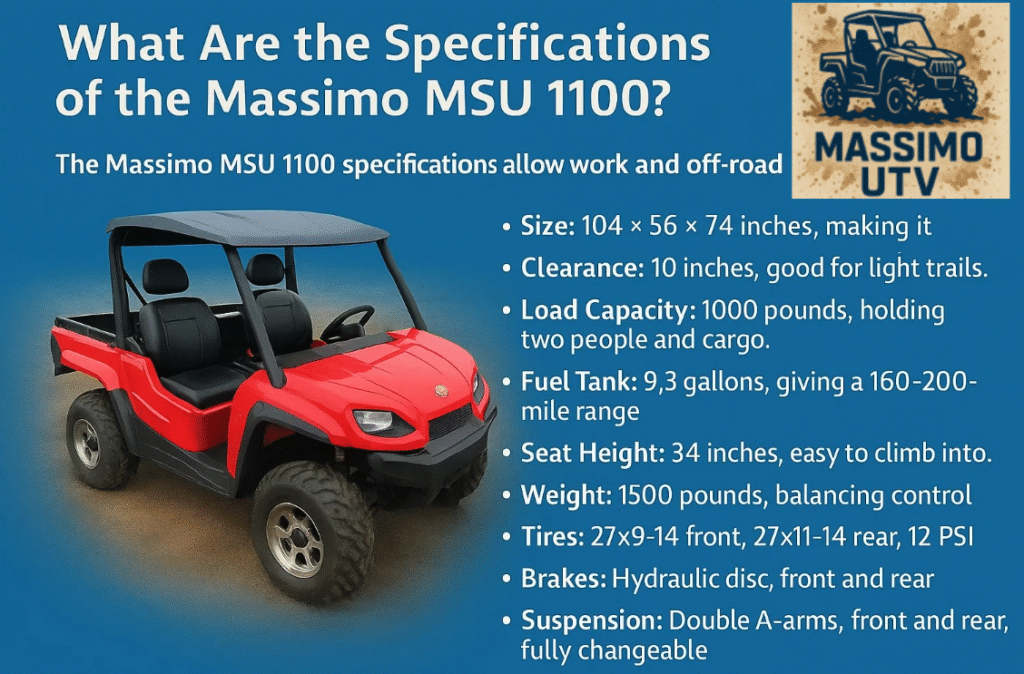
The Massimo MSU 1100 specifications allow work and off-road fun:
- Size: 104 x 56 x 74 inches, making it compact.
- Clearance: 10 inches, good for light trails.
- Load Capacity: 1000 pounds, holding two people and cargo.
- Fuel Tank: 9.3 gallons, giving a 160–200-mile range.
- Seat Height: 34 inches, easy to climb into.
- Weight: 1500 pounds, balancing control.
- Tires: 27×9-14 front, 27×11-14 rear, 12 PSI.
- Brakes: Hydraulic disc, front and rear.
- Suspension: Double A-arms, front and rear, fully changeable.
- Top Speed: 50 mph, dropping to 30 mph on rough terrain.
These specs are similar to the Hisun 1100, allowing shared parts. The 1085cc engine handles heavy jobs, if cared for every 500 miles.
What Is the Engine of the Massimo MSU 1100?

The Massimo MSU 1100 has a 1085cc V-twin, four-stroke, DOHC engine, making 38 horsepower at 6500 RPM. The 92mm x 81.4mm bore and stroke and 9.5:1 compression ratio help 2000-pound towing. The liquid-cooled EFI system keeps it cool, giving 55 ft-lbs torque at 4000 RPM.
It reaches 50 mph, slowing to 30 mph on hills. It meets EPA rules, cutting emissions. This is like the Bennche 1100, staying reliable, if checked every 500 miles.
What Are the Features of the Massimo MSU 1100 Engine?
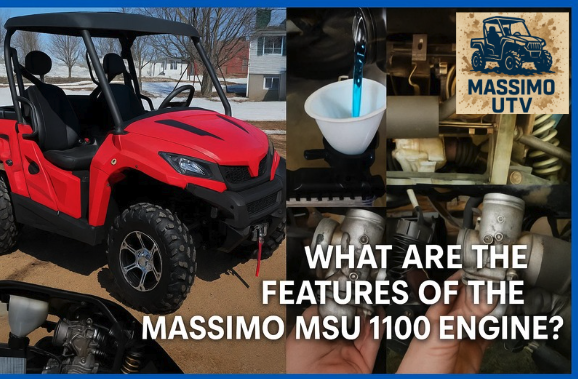
The Massimo MSU 1100 engine gives 38 horsepower with a 1085cc V-twin, four-stroke build. Key features include:
- V-Twin: Makes 38 horsepower, great for work tasks.
- Four-Stroke Cycle: Follows EPA rules, lowering emissions.
- Liquid Cooling: Stops overheating, keeping power steady.
- EFI System: Gives precise fuel, boosting efficiency.
- Compression Ratio: 9.5:1, helping reach 50 mph.
- ECU Ignition: Keeps timing steady on all terrains.
- DOHC: Improves efficiency, adding durability.
- Oil Capacity: 3.2–3.4 quarts of 10W-40, keeping parts lubricated.
- Fuel System: 40mm throttle body helps EFI.
- Exhaust: Catalytic converter cuts emissions, resists rust.
These features are similar to the Hisun 1100, giving steady performance, if cared for regularly.
What Are the Common Problems with the Massimo MSU 1100 Engine?

The Massimo MSU 1100 engine has ten common problems, needing regular care:
- Overheating: Dirty radiator fins raise temperatures.
- Injector Clogs: Bad fuel causes starting issues.
- Vibration: V-twin shakes at high RPMs.
- Oil Leaks: Seals wear out, losing oil after 1000 miles.
- Weak Power: 38-horsepower struggles with heavy loads.
- Starter Issues: ECU fails in cold weather, stopping starts.
- Piston Wear: 92mm pistons wear without oil changes.
- Fuel Pump Trouble: Ethanol damages fuel flow.
- Loud Exhaust: Muffler silencer breaks, making noise.
- Slow Throttle: EFI lags, slowing acceleration.
These need Hisun 1100-shared parts like injectors ($50). Care is like Bennche 1100 reliability.
How Can Owners Fix Engine Problems in the Massimo MSU 1100?

Owners fix Massimo MSU 1100 engine problems with ten steps:
- Stop Overheating: Clean radiator fins monthly ($10).
- Clean Fuel System: Replace fuel filter every 500 miles ($10).
- Reduce Vibration: Tighten mounts every 500 miles with pads ($15).
- Fix Oil Leaks: Replace seals every 1000 miles ($10).
- Boost Power: Tune EFI yearly for 38 horsepower ($20).
- Fix Starter: Check ECU every 1000 miles, replacing ($40).
- Protect Pistons: Change oil every 500 miles with 10W-40 ($20).
- Replace Fuel Pump: Clean tank yearly, replacing pump ($50).
- Quiet Exhaust: Check muffler every 500 miles ($90).
- Fix Throttle Lag: Clean injector every 1000 miles ($10).
These use Bennche 1100-shared parts, keeping it reliable, if done often.
What Are the Parts of the Massimo MSU 1100?
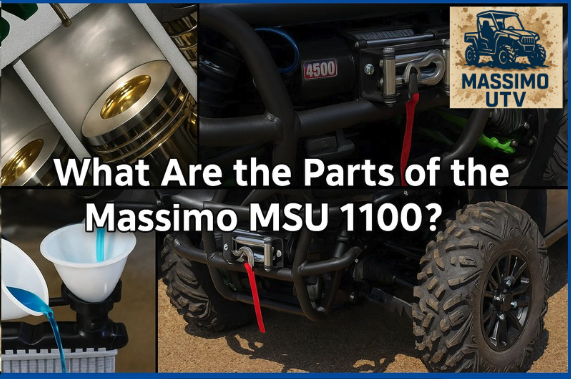
The Massimo MSU 1100 has ten main part categories:
- Piston Kit: Works with 1085cc engine, $80.
- CVT Belt: Keeps transmission smooth, $50.
- Brake Pads: Stops vehicle, $30.
- Oil Filter: Protects engine, $10–$15.
- Fuel Filter: Stops injector clogs, $10.
- Tires: 27×9-14 front, $120 each.
- Battery: 12V, 30Ah, powers systems, $60.
- Winch Cable: Works with 4500-pound winch, $20.
- A-Arms: Improve suspension, $90 per pair.
- Ignition Coil: Sparks engine, $50.
These are like Hisun 1100 parts, saving money, if bought from massimomotor.com or Amazon.
Where Can Owners Find the Massimo MSU 1100 Parts Diagram?

The Massimo MSU 1100 parts diagram is found at Massimo Motor Sports or HisunPartsCentral. It shows:
- Engine Diagram: Piston (#17114050120), oil filter mount.
- Transmission Diagram: CVT belt, clutch weights (#45).
- Chassis Diagram: A-arms, shock mounts.
- Electrical Diagram: Battery, ECU connections.
Download from manualslib.com, similar to Bennche 1100, to help with fixes, if kept handy.
What Is the Oil Filter for the Massimo MSU 1100?
The Massimo MSU 1100 uses a spin-on oil filter with a 10-micron rating, part number 15200-001-0000. It costs $10–$15 and protects the 1085cc engine from dirt. Replace every 500 miles, like the Hisun 1100, to keep the engine healthy.
What Is the Oil Filter Cross-Reference for the Massimo MSU 1100?
The Massimo MSU 1100 oil filter matches five other filters:
- Fram PH6017A: Fits 1085cc engine, $10–$12.
- K&N HP-7009: Allows high flow, $12–$15.
- WIX 51356: Fits thread size, $10–$12.
- Purolator PL10241: Keeps oil flowing, $8–$10.
- Mobil 1 M1-110A: Handles heat, $12–$15.
These are like Bennche 1100, keeping engine oil clean, if changed every 500 miles.
What Is the Oil Capacity of the Massimo MSU 1100?
The Massimo MSU 1100 holds 3.2–3.4 quarts of 10W-40 synthetic blend oil for its 1085cc engine. This lubricates the 92mm pistons, helping 38 horsepower. Change oil every 500 miles, like the Hisun 1100, to keep the engine strong.
What Are the Accessories for the Massimo MSU 1100?

The Massimo MSU 1100 works with ten accessories for better use:
- Winch: 4500-pound pull, $300, for stuck vehicles.
- Windshield: Full plastic, $150, blocks debris.
- Roof: Hard poly, $250, keeps out rain.
- Bumper: Steel front, $200, takes hits.
- Hitch: 2-inch, $50, hooks trailers.
- Bed Liner: Rubber, $100, saves bed.
- LED Bar: 20-inch, $80, brightens paths.
- Tires: 27×9-14 all-terrain, $500 for set, for grip.
- Skid Plates: Guards bottom, $100.
- Better Exhaust: Adds power, $200.
These are like Polaris Ranger 1000, making it more useful, if added correctly.
What Are the Common Problems with Massimo MSU 1100 Accessories?
Massimo MSU 1100 accessories have ten problems:
- Winch Stops: Cables break, weakening pull.
- Windshield Cracks: Rocks cause breaks, blocking view.
- Roof Shakes: Loose bolts make noise.
- Bumper Dents: Hits damage steel, losing protection.
- Hitch Wear: Wears under heavy towing.
- Bed Liner Tears: Heavy loads rip rubber.
- LED Failure: Bulbs burn out, dimming light.
- Tire Wear: New tires wear unevenly without alignment.
- Skid Plate Dents: Hits damage plates, losing protection.
- Exhaust Noise: New exhaust gets too loud.
These need Hisun 1100-shared parts, like Bennche 1100 reliability, if fixed often.
How Can Owners Keep Accessories Working on the Massimo MSU 1100?
Owners keep Massimo MSU 1100 accessories working with ten steps:
- Check Winch: Look at cables every 500 miles, replacing ($20).
- Clean Windshield: Use anti-fog cleaner weekly ($5).
- Tighten Roof: Fix bolts every 500 miles ($5).
- Check Bumper: Inspect for dents every 500 miles ($10).
- Fix Hitch: Check wear yearly ($10).
- Replace Bed Liner: Swap torn liner yearly ($100).
- Replace LEDs: Change bulbs every 2 years ($15).
- Rotate Tires: Move tires every 1000 miles to save wear ($10).
- Check Skid Plates: Look for dents every 500 miles ($20).
- Check Exhaust: Look at silencer yearly ($90).
These use MSU 1100-shared parts, keeping things reliable, if done regularly.
What Are the Common Problems with the Massimo MSU 1100?
The Massimo MSU 1100 has ten common problems, needing regular care:
- Electrical Shorts: Rusty wires cause dim lights or no start.
- Injector Clogs: Bad fuel stops engine.
- Transmission Grinding: Low fluid causes rough shifts.
- Overheating: Dirty radiator raises engine heat.
- Brake Fade: Worn pads weaken stopping.
- Vibration: Loose mounts shake at high RPMs.
- Fuel Pump Failure: Ethanol clogs pump, cutting flow.
- Slow Speed: Belt slips, reducing power.
- Suspension Squeaks: Bushings squeak without grease.
- Oil Pressure Drop: Dirty filter lowers pressure.
These need Bennche 1100-shared parts like belts ($50). Care is like Hisun 1100 reliability.
How Can Owners Fix Problems in the Massimo MSU 1100?

Owners fix Massimo MSU 1100 problems with ten steps:
- Fix Electrical Shorts: Clean wires with brush ($5), replace ($80).
- Clean Injector: Use $30 kit every 1000 miles.
- Stop Grinding: Add 2.0 quarts Dexron VI ATF ($20).
- Stop Overheating: Clean radiator fins ($0), add fan switch ($20).
- Fix Brakes: Replace pads ($30), add fluid ($5).
- Reduce Vibration: Tighten mounts at 35 ft-lbs ($0).
- Replace Fuel Pump: Add $10 filter, check 43 PSI.
- Boost Speed: Replace belt ($50), clean pulleys.
- Stop Squeaks: Grease bushings every 500 miles ($5).
- Fix Oil Pressure: Change filter every 500 miles ($10).
These use Hisun 1100-shared parts, keeping it reliable, if done often.
What Is the Transmission System of the Massimo MSU 1100?

The Massimo MSU 1100 has a CVT transmission with a shaft-driven system and wet clutch. It has low, high, neutral, and reverse settings, sending 38 horsepower to 27-inch tires. The selectable 2WD/4WD boosts grip.
It reaches 50 mph and pulls 2000 pounds, held steady by 10-inch clearance. The clutch kit keeps shifts smooth, and the shaft drive needs less care. This is like the Hisun 1100, working well, if checked every 500 miles.
What Are the Common Transmission Problems in the Massimo MSU 1100?
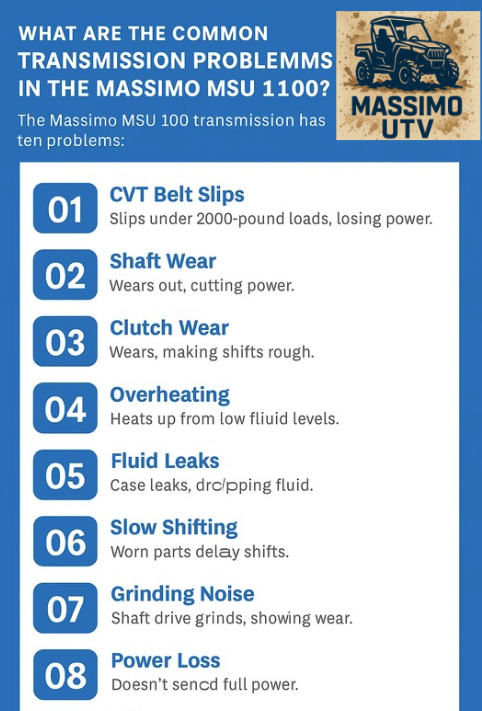
The Massimo MSU 1100 transmission has ten problems:
- CVT Belt Slips: Slips under 2000-pound loads, losing power.
- Shaft Wear: Wears out, cutting power.
- Clutch Wear: Wears, making shifts rough.
- Overheating: Heats up from low fluid levels.
- Fluid Leaks: Case leaks, dropping fluid.
- Slow Shifting: Worn parts delay shifts.
- Grinding Noise: Shaft drive grinds, showing wear.
- Power Loss: Doesn’t send full power.
- Vibration: Drivetrain shakes, reducing comfort.
- Belt Wear: CVT belt wears out without care.
These need Bennche 1100-shared parts like belts ($50). Care is like Hisun 1100 reliability.
How Can Owners Keep the Transmission of the Massimo MSU 1100 Working?
Owners keep the Massimo MSU 1100 transmission working with ten steps:
- Check CVT Belt: Look every 500 miles, replacing worn belts ($50).
- Add Fluid: Use Dexron VI ATF monthly ($20).
- Replace Clutch Kit: Put in new kit every 2000 miles ($100).
- Check Fluid Levels: Look at ATF monthly ($15).
- Fix Leaks: Replace seals every 1500 miles ($10).
- Fix Shifting: Tune CVT every 1000 miles per manual.
- Stop Grinding Noise: Check shaft drive every 500 miles ($50).
- Boost Power: Clean transmission yearly.
- Reduce Vibration: Tighten parts every 500 miles ($5).
- Fix Belt Tension: Change tension every 1000 miles.
These use Hisun 1100-shared parts, keeping it reliable, if towing often.
What Are the Electrical Parts of the Massimo MSU 1100?
The Massimo MSU 1100 electrical system has ten parts:
- Battery: 12V, 30Ah, powers ignition and lights.
- Starter Motor: Starts engine, using 300 amps.
- Alternator: Charges battery, giving 15 amps.
- Wiring: Connects parts, helping power flow.
- Ignition Switch: Turns system on, starting engine.
- LED Headlights: Light up paths.
- Circuit Breaker: Stops circuit overloads.
- Sensors: Watch engine performance.
- Digital Dash: Shows speed, fuel, and diagnostics.
- Winch Switch: Runs 4500-pound winch.
These are like Bennche 1100, staying reliable, if checked every 500 miles.
What Are the Common Electrical Problems in the Massimo MSU 1100?
The Massimo MSU 1100 electrical system has ten problems:
- Battery Failure: Stops working after 2 years, preventing starts.
- Starter Issues: Motor fails in cold weather.
- Wiring Breaks: Wires wear, causing shorts.
- Alternator Failure: Stops charging, draining battery.
- Headlight Failure: LED bulbs burn out, dimming light.
- Breaker Trips: Trips from too many accessories.
- Sensor Issues: Give wrong readings, hurting performance.
- Dash Problems: Digital display stops working.
- Winch Switch Failure: Stops winch from working.
- Ignition Switch Failure: Stops starts, needing replacement.
These need Hisun 1100-shared parts, like Bennche 1100 reliability.
How Can Owners Keep the Electrical System of the Massimo MSU 1100 Working?
Owners keep the electrical system working with ten steps:
- Check Battery: Test every 500 miles, replacing every 2 years ($60).
- Look at Starter: Test yearly, replacing ($50).
- Check Wiring: Look every 500 miles for breaks ($5).
- Test Alternator: Check output weekly, giving 15 amps.
- Replace Headlights: Change LED bulbs every 2 years ($15).
- Check Breakers: Look at breaker box every 500 miles, replacing ($5).
- Test Sensors: Check readings yearly ($10).
- Fix Dash: Check connections yearly ($10).
- Check Winch Switch: Test every 500 miles, replacing ($20).
- Look at Ignition Switch: Test yearly, replacing ($10).
These use MSU 1100-shared parts, keeping things reliable, if checked often.
What Are the Suspension Features of the Massimo MSU 1100?
The Massimo MSU 1100 suspension has ten features:
- Double A-Arms: Front and rear, changeable for load.
- Shock Absorbers: Soak up bumps from rough terrain.
- Clearance: 10 inches to clear obstacles.
- Rust Protection: Coating fights corrosion in wet areas.
- Tire Fit: Works with 27-inch tires for grip.
- Load Capacity: Holds 1000-pound loads.
- Towing Capacity: Pulls 2000 pounds without strain.
- Durability: Handles light trails, like Hisun models.
- Stability: Stays steady on hills.
- Changeability: Shocks change for rider weight.
These give stability, like Polaris Ranger 1000, if checked every 500 miles.
What Are the Common Suspension Problems in the Massimo MSU 1100?
The Massimo MSU 1100 suspension has ten problems:
- Shock Wear: Wears under heavy loads, reducing comfort.
- Alignment Issues: A-arms shift, wearing tires.
- Rust: Coating wears off, causing rust.
- Squeaking: Bushings squeak without grease.
- Lower Clearance: Suspension sags, cutting 10-inch clearance.
- Change Failure: Shocks won’t lock, causing uneven rides.
- Tire Stress: Bigger tires strain suspension.
- Towing Wear: Wears when pulling 2000 pounds.
- Part Wear: Parts wear on rough terrain.
- Stability Issues: Wobbles on steep hills.
These need Bennche 1100-shared parts, like Hisun 1100 reliability.
How Can Owners Keep the Suspension of the Massimo MSU 1100 Working?
Owners keep the suspension working with ten steps:
- Check Shocks: Look every 500 miles, replacing leaks ($50).
- Fix Alignment: Realign A-arms every 1000 miles ($10).
- Add Coating: Reapply coating yearly ($10).
- Grease Bushings: Grease every 500 miles ($5).
- Check Clearance: Measure weekly to confirm 10 inches.
- Change Shocks: Test every 500 miles for steadiness.
- Check Tires: Make sure tire size fits to avoid stress.
- Limit Towing: Keep towing under 1500 pounds to reduce wear.
- Replace Parts: Check every 500 miles, replacing ($50).
- Test Stability: Check on hills every 500 miles.
These use MSU 1100-shared parts, keeping things reliable, if done often.
How Does the Massimo MSU 1100 Compare to Other Massimo Models?

The Massimo MSU 1100 offers strong power compared to five Massimo models:
- T-Boss 410: 352cc engine, 25.5 horsepower, $7,999, shares oil filters.
- Buck 450: 352cc engine, 25 horsepower, $7,999, shares brake pads.
- T-Boss 560: 493cc engine, 33 horsepower, $9,999, shares CVT belts.
- MSU 850: 800cc engine, 59 horsepower, $9,999, shares fuel filters.
- Warrior 1000 MXD: 1000cc engine, 85 horsepower, $16,999, shares winch cables.
The MSU 1100 is stronger than MSU 850, good for heavy tasks.
How Does the Massimo MSU 1100 Compare to Other UTV Brands?
The Massimo MSU 1100 compares to five other UTVs:
- Hisun 1100: 1085cc, 38 horsepower, $12,000, shares CVT belts.
- Bennche 1100: 1085cc, 36 horsepower, $11,500, shares brake pads.
- Polaris Ranger 1000: 999cc, 61 horsepower, $15,000, shares oil filters.
- CFMoto UForce 1000: 963cc, 79 horsepower, $13,500, shares fuel filters.
- John Deere Gator XUV 825i: 812cc, 50 horsepower, $14,999, shares air filters.
The MSU 1100 gives good value, like Hisun 1100, if thinking about price.
| Feature | Massimo MSU 1100 | Hisun 1100 | Polaris Ranger 1000 |
|---|---|---|---|
| Horsepower | 38 | 38 | 61 |
| Weight | 1500 lbs | 1450 lbs | 1600 lbs |
| Price | $12,500 | $12,000 | $15,000 |
| Extras | Winch | Basic | Better Steering |
What Are the Common Overheating Problems in the Massimo MSU 1100?
The Massimo MSU 1100 has five overheating problems:
- Dirty Radiator Fins: Dirt blocks airflow, raising heat.
- Low Coolant: Coolant runs low, cutting cooling.
- High RPMs: Long runs build up heat.
- Hot Weather: Extreme heat stresses the system.
- Heavy Loads: 2000-pound towing adds heat.
Clean radiator fins monthly and check coolant every 500 miles, like Hisun 1100, to stop overheating.
How Can Owners Fix Overheating Problems in the Massimo MSU 1100?
Owners fix overheating with five steps:
- Clean Radiator Fins: Clear dirt monthly ($10).
- Check Coolant: Look weekly, adding more ($10).
- Watch RPMs: Avoid long high RPMs.
- Reduce Loads: Limit towing to 1500 pounds in heat.
- Check Temperature: Watch gauges daily in hot weather.
These use Bennche 1100-shared parts, keeping it reliable, if done often.